5. Read & Write Pipelines
5.1 Write Pipeline: Remember
mnemon remember is the core command for writing memories. It includes a built-in diff step that automatically detects duplicates and conflicts before storage. The write transaction executes atomically within a single SQLite transaction.
Detailed Flow
mnemon remember "Chose Qdrant as the vector database" \
  --cat decision --imp 5 --entities "Qdrant,Milvus"
Step 1: Validate Input
- Category must be one of the six types
- Importance 1-5
- Content must not exceed 8000 characters
- Up to 20 tags and 50 entities
Step 2: Generate Embedding (outside transaction)
- If Ollama is available: HTTP POST -> nomic-embed-text -> 768-dim float64 vector
- If unavailable: embedding = nil, falls back to token overlap downstream
Step 2.5: Built-in Diff (outside transaction, read-only)
Compute advisory similarity suggestions and check exact content against all active insights:
- Byte-identical content → skip insert, return
action="skipped"anddiff_suggestion="DUPLICATE" - Different content → normal insert with
action="added", preserving the heuristicdiff_suggestionfor review
Similarity uses embedding cosine when available, falling back to token overlap.
Neither similarity nor extracted entities establish that one fact supersedes
another. Exact-content lookup is independent of similarity candidate limits.
The --no-diff flag disables both checks and inserts even exact repeats.
Step 3: Atomic Transaction
BEGIN TRANSACTION
  ① INSERT insight (UUID, content, category, importance, tags, entities, source)
  ② UPDATE embedding (if vector is available)
  ③ Graph Engine: OnInsightCreated
     ├── CreateTemporalEdge    → backbone + 24h proximity
     ├── CreateEntityEdges     → regex + dictionary extraction → co-occurrence links
     ├── CreateCausalEdges     → keywords + token overlap → auto causal edges
     └── CreateSemanticEdges   → cos >= 0.80 auto-link
  ④ RefreshEffectiveImportance → update EI decay values
  ⑤ AutoPrune                 → soft-delete lowest EI older than grace period
                                 + required per-ID oplog record
COMMIT
Step 4: Candidate Output (post-transaction, read-only)
FindSemanticCandidates: Semantic candidates with cos in [0.40, 0.80)FindCausalCandidates: Causal candidates in the 2-hop BFS neighborhood
Step 5: JSON Output
{
  "id": "abc-123",
  "action": "added",
  "diff_suggestion": "ADD",
  "edges_created": {"temporal": 2, "entity": 3, "causal": 1, "semantic": 1},
  "semantic_candidates": [
    {"id": "def-456", "content": "...", "cosine": 0.72, "auto_linked": false}
  ],
  "causal_candidates": [
    {"id": "ghi-789", "content": "...", "hop": 1, "suggested_sub_type": "causes"}
  ],
  "embedded": true,
  "effective_importance": 0.85,
  "auto_pruned": 0,
  "auto_pruned_ids": []
}
The action field is "added" (new entry) or "skipped" (byte-identical active
content, no insert). On a skipped repeat, the legacy replaced_id field names
the existing memory; it is not deleted or changed. A heuristic UPDATE,
CONFLICT, or near-DUPLICATE suggestion still produces action="added".
After receiving this output, the LLM can evaluate candidates and establish edges it considers appropriate via the mnemon link command.
5.2 Read Pipeline: Smart Recall
mnemon recall is Mnemon's core retrieval algorithm. Smart recall is the default mode for all queries. It combines intent detection, multi-signal anchor selection, Beam Search graph traversal, and multi-factor re-ranking to achieve intent-aware graph-enhanced retrieval. Use --basic for legacy SQL LIKE fallback.
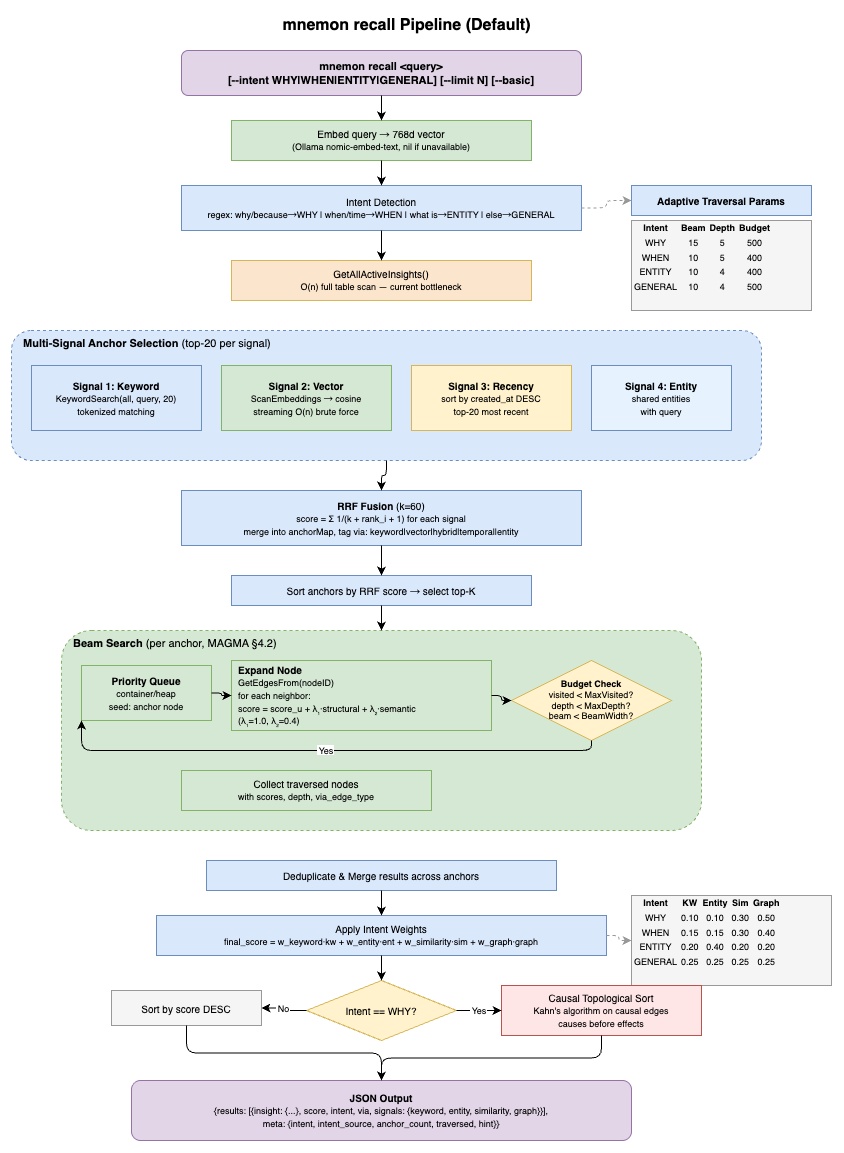
Step 1: Intent Detection
Query intent is selected with a fixed set of local lexical patterns. The original English/Chinese cues include:
| Intent | Trigger Patterns |
|---|---|
| WHY | why, reason, because, cause, motivation, 为什么, 原因, 理由 |
| WHEN | when, time, before, after, timeline, 什么时候, 何时, 时间 |
| ENTITY | what is, who is, tell me about, 是什么, 谁是, 关于 |
| GENERAL | None of the above match |
Question forms also cover Hindi, Spanish, Modern Standard Arabic, French, Bengali, Portuguese, Indonesian, Russian, and German. See recall intent detection for supported scripts, examples, and limits. Matching uses Unicode word boundaries for spaced scripts. Conflicting cues involving an additional language fall back to GENERAL; legacy English/Chinese-only queries retain keyword scoring and the ENTITY tie-break. This is a bounded heuristic, not semantic language understanding.
--intent WHY|WHEN|ENTITY|GENERAL overrides detection in any query language.
The host can supply intent from the user's meaning without translating the query
or invoking another provider. --verbose exposes meta.intent and
meta.intent_source (auto or override).
Step 2: Multi-Signal Anchor Selection (RRF Fusion)
Multiple signals run in parallel and are merged via Reciprocal Rank Fusion:
Signal 1: Keyword     → KeywordSearch(all_insights, query, top-20)
Signal 2: Vector      → CosineSimilarity(query_vec, all_embeddings, top-20)
Signal 3: Recency     → sort by created_at DESC, top-20
Signal 4: Entity      → insights sharing entities with the query

RRF Score = Σ  1 / (k + rank_i + 1)    (k = 60)
                 for each signal
Each insight may rank differently across signals; RRF fusion produces a robust composite ranking.
Step 3: Beam Search Graph Traversal
Starting from each anchor, Beam Search is performed across the four graphs:
for each anchor:
    priority_queue = [(anchor, initial_score)]
    visited = {}

    while budget_remaining:
        node = pop(priority_queue)
        for edge in GetEdgesFrom(node):
            neighbor = edge.target
            structural_score = edge.weight × intent_weight[edge.type]
            semantic_score = cosine(vec_neighbor, vec_query)
            total = score_node + λ₁·structural + λ₂·semantic
            //  λ₁ = 1.0 (structural weight), λ₂ = 0.4 (semantic weight)

            if total > best_score[neighbor]:
                update(neighbor, total)
                push(priority_queue, neighbor)
Adaptive parameters:
| Intent | Beam Width | Max Depth | Max Visited |
|---|---|---|---|
| WHY | 15 | 5 | 500 |
| WHEN | 10 | 5 | 400 |
| ENTITY | 10 | 4 | 400 |
| GENERAL | 10 | 4 | 500 |
WHY queries use a wider beam and deeper traversal because causal chains typically span multiple hops.
Step 4: Multi-Factor Re-Ranking
For all collected candidates, a four-dimensional score is computed and combined via weighted sum:
keyword_score  = token_intersection / query_token_count
entity_score   = matched_entities / max(1, query_entities_count)
similarity     = cosine(vec_candidate, vec_query)
graph_score    = (traversal_score - min) / (max - min)   // min-max normalization

final = w_kw·keyword + w_ent·entity + w_sim·similarity + w_gr·graph
Weights vary by intent:
| Intent | Keyword | Entity | Similarity | Graph |
|---|---|---|---|---|
| WHY | 0.10 | 0.10 | 0.30 | 0.50 |
| WHEN | 0.15 | 0.15 | 0.30 | 0.40 |
| ENTITY | 0.20 | 0.40 | 0.20 | 0.20 |
| GENERAL | 0.25 | 0.25 | 0.25 | 0.25 |
Step 5: WHY Post-Processing — Causal Topological Sort
If the intent is WHY, an additional topological sort using Kahn's algorithm is performed: results are arranged along causal edges so that causes come first, effects follow.
Signal Transparency
Each retrieval result includes a detailed signal breakdown:
{
  "insight": {"id": "...", "content": "..."},
  "score": 0.73,
  "intent": "ENTITY",
  "via": "keyword",
  "signals": {
    "keyword": 0.85,
    "entity": 0.60,
    "similarity": 0.72,
    "graph": 0.45
  }
}
This is a unique innovation in Mnemon: exposing the retrieval pipeline's internal signals to the host LLM. Since the host LLM has the full conversation context, it can make better re-ranking judgments than any algorithm inside the pipeline.
5.3 Deduplication & Conflict Detection: Diff
flowchart TD
    Write[remember / import] --> Bypass{"--no-diff?"}
    Bypass -->|Yes| Add[Insert new memory; preserve existing facts]
    Bypass -->|No| Exact{Byte-identical active content?}
    Exact -->|Yes| Skip[Skip insert; identify existing memory]
    Exact -->|No| Add
    Write -. remember only .-> Advisory[Similarity suggestions for review]
Diff is built into remember — no separate call needed. When mnemon remember is invoked, it automatically runs a diff check before inserting.
When remember is called, the built-in diff runs before the transaction:
- Compute similarity against all active insights (embedding cosine when available, token overlap as fallback)
- Independently scan all active insights for byte-identical content. Similarity suggestions describe possible relationships; exact equality alone permits a skip:
| Content | Diff suggestion | Behavior |
|---|---|---|
| Byte-identical to an active memory | DUPLICATE | Skip insert, return action="skipped" |
| Different at any similarity | ADD, UPDATE, CONFLICT, or DUPLICATE | Insert with action="added"; retain the existing memory |
import uses the same exact-content lookup and preserves distinct content.
The --no-diff flag allows unconditional insertion on either command.
Capacity-based auto-pruning remains a separate lifecycle policy.
Typical Workflow
Store new content, then retire a specific old fact only when appropriate:
# Diff suggestions are automatic and advisory
mnemon remember "Chose PostgreSQL to replace SQLite as the primary database" \
  --cat decision --imp 5 --source agent
# → Exact repeat: action="skipped"; existing memory unchanged
# → Different content: action="added"; existing memories retained

# If the new fact supersedes a specific old memory, verify before retiring it
mnemon show <new-id>
mnemon forget <old-id>